
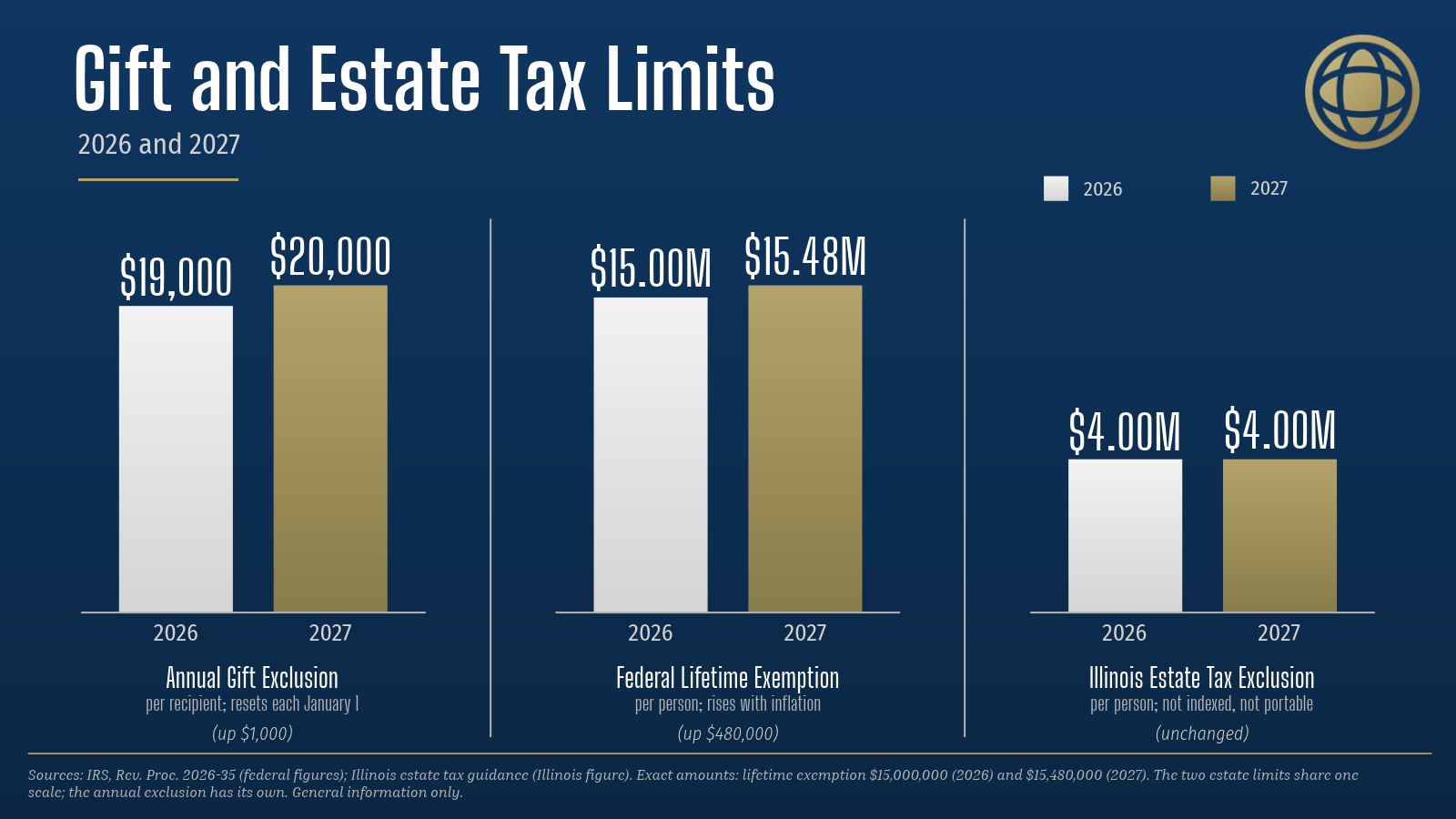
On November 5, the IRS announced that the annual gift tax exclusion rises from $19,000 to $20,000 per recipient on January 1, 2027, and that the federal lifetime exemption rises from $15 million to $15.48 million per person.* For families in Illinois, a smaller number often matters more: the state’s $4 million estate tax exclusion.**
The annual exclusion is the amount one person can give another in a year without it counting against anything. The lifetime exemption is the total a person can give away, during life or at death, before federal estate or gift tax applies. Below, you will find how the 2027 numbers work, how year-end gifting runs across two tax years, and how Illinois changes the picture.
What the 2027 Numbers Are
The annual exclusion is $20,000 per recipient in 2027, and the lifetime exemption is $15.48 million per person.* Annual exclusion gifts are a sensible default, because the exclusion is use-it-or-lose-it every year, which makes them simple and low regret.
The Annual Exclusion: $20,000 Per Recipient
A person can give $20,000 to as many people as they like in 2027 without using any lifetime exemption.* A married couple can combine for $40,000 per recipient by splitting gifts, which requires filing a gift tax return. Through December 31, 2026, the amount is $19,000.
The exclusion resets every year and does not carry forward, so an unused year is gone for good. That is why annual gifts are simple to make and hard to regret.
The Lifetime Exemption: $15.48 Million Per Person
The lifetime exemption covers gifts above the annual exclusion made during life, plus the estate left at death.* Using it does not mean writing a check to the IRS. A gift above the annual exclusion usually just means filing a gift tax return, and tax is owed only after total lifetime gifts pass the exemption.
Two misunderstandings come up often. The first is that the exemption only matters for the ultra-wealthy, which is often wrong in Illinois, where the state’s estate tax starts at $4 million. The second is that a married couple automatically gets double. Carrying over the first spouse’s unused federal exemption requires filing an estate tax return after the first death, and Illinois does not allow the carryover at all. Even at today’s higher federal number, the law can change, so plans built with flexibility hold up better than plans built around one number.
Gifts That Do Not Count
Some gifts fall outside the limits altogether. Gifts to a spouse who is a U.S. citizen are unlimited, and the annual exclusion for gifts to a spouse who is not a U.S. citizen rises to $201,000 in 2027.* Payments made directly to a school for tuition, or directly to a provider for medical care, also do not count against the limits.
How Year-End Gifting Works Across Two Years
Year-end gifting spans two calendar years because each year has its own annual exclusion. A gift made by December 31, 2026 falls under the $19,000 limit, and a gift made on or after January 1, 2027 falls under $20,000.*
Two Calendar Years, Two Limits
Gifts made by December 31, 2026 use the $19,000 exclusion, so a married couple can give up to $38,000 per recipient this year. Starting January 1, the amount becomes $20,000, or $40,000 for a couple. Because the exclusion resets each year, a donor can use both years in close succession. Gifts above the annual amount are reported on a gift tax return, Form 709.
Annual Gifts First, Larger Transfers Second
Larger transfers come only after a long-range plan shows the family is secure without the money. The rule that matters most is that money that might be needed later should not be given away.
Larger transfers tend to make sense in two situations. One is when the estate is clearly over the federal or Illinois threshold. The other is when an asset is expected to grow, such as a business interest or real estate. In that second case, getting the future growth out of the estate often matters more than the dollar amount today. Readiness belongs in the decision alongside the tax math: whether the recipients are prepared to receive the money matters as much as the numbers.
Fair Is Not Always Equal
The conversation should come before the documents. A family discussion about what each child expects and what the parents intend prevents a lot of hurt later, and it is far easier while everyone is alive.
When one child works in the family business and the others do not, the gap can be balanced with life insurance or other assets for the children outside the business. Keeping a record of lifetime gifts also lets them be counted later if equal treatment is the goal. In blended families, the central question is whether assets end up with the people the owner intends, especially children from a prior marriage when a surviving spouse is in control. The right trust structure usually handles that.
Illinois Adds Its Own Estate Tax
Illinois taxes estates above $4 million, a threshold far below the federal $15.48 million that is not adjusted for inflation.** For many Illinois families, that line shapes gifting decisions more than the federal number does.
A $4 Million Line That Is Easy to Cross
Plenty of families cross $4 million once everything is counted: the home, retirement accounts, a business, and life insurance death benefits. The way Illinois calculates the tax can also create a steep jump just above the threshold, so a small amount over the line can bring a large tax bill.**
Two Spouses, Two $4 Million Exclusions
Illinois does not allow a surviving spouse to carry over the first spouse’s unused exclusion, so each spouse’s $4 million is either used or lost.** For married couples, the plan usually needs to make use of both, and a trust at the first death is the common way to do it.
Gifting and Life Insurance in Illinois
Illinois has no gift tax, and gifts within the annual exclusion leave the Illinois estate entirely. Larger taxable gifts are generally added back when Illinois tests the $4 million threshold, so they help less.** Life insurance deserves a look for the same reason as the home and business: death benefits can count toward the estate, so how a policy is owned can decide whether it pushes the estate over the line.
Frequently Asked Questions
The annual gift tax exclusion is $20,000 per recipient in 2027, up from $19,000 in 2026.* A married couple can combine for $40,000 per recipient by splitting gifts. Gifts within the exclusion generally do not use any of the lifetime exemption.
Usually not right away. A gift above the annual exclusion generally requires a gift tax return and reduces the lifetime exemption, which is $15.48 million per person in 2027.* Tax is owed only once total lifetime gifts exceed that amount.
No. Illinois does not tax gifts made during life. It does have an estate tax that applies above $4 million, and it generally adds larger taxable gifts back when it tests that threshold.** Gifts within the annual exclusion are not added back.
Federally, a surviving spouse can carry over the first spouse’s unused exemption, but only by filing an estate tax return after the first death. Illinois does not allow that carryover, so a married couple’s two $4 million exclusions generally need to be planned for, often through a trust.**
In 2027, the federal exemption is $15.48 million and rises with inflation, while the Illinois exclusion stays at $4 million.
* IRS, Rev. Proc. 2026-35 and news release on 2027 inflation adjustments, IRS. KPMG, summary of Rev. Proc. 2026-35.
** Illinois estate tax: Thompson Flaherty, Illinois Estate Tax at $4 Million. Settled Estate, Illinois Estate Tax. Woods & Bates, Is There an Illinois Gift Tax?.
The information in this newsletter is provided for informational and educational purposes only. No client or potential client should assume that any information presented or made available on or through this blog should be construed as personalized financial planning or investment advice. Personalized financial planning and investment advice can only be rendered after engagement of the firm for services, execution of the required documentation, and receipt of required disclosures. Please contact the firm for further information.
Advisory services offered through Three Sixty FBO, LLC an SEC registered Investment Advisor. Registration with the SEC does not imply a certain level of skill or expertise. Additional information about Three Sixty FBO, LLC is available in its current disclosure documents, Form ADV, Form ADV Part 2A Brochure, and Client Relationship Summary report which are accessible online via the SEC’s investment Adviser Public Disclosure (IAPD) database at https://adviserinfo.sec.gov/firm/summary/301007. Three Sixty FBO, LLC does not offer or provide legal advice. Please consult your attorney for such services.